 Future Performance Training
Planning your tasks and time
Create a Task List
Everyone has specific objectives that need to be met. Once you have decided what your objectives are, you have to work towards achieving them. This entails scheduling your time in order to make provision for those tasks which will ensure that you reach your objectives.
You may use certain tools to help you in the scheduling of your business activities, tools such as:
- A to do list
- A Dairy
- Planners
To-do list
You should begin each working day by planning the tasks to be performed that day. This list may be drawn up on a daily or weekly basis\depending on your type of work. However, it is important that the list be reviewed every day. Completed tasks need to be crossed off and additional tasks added.
A to-do list is as indispensable in time management as the carefully devised business plan in the acquisition of corporate capital.
How can you ensure that this list will be effective?
- Make it a habit to list all the things you need to do.
- Be realistic about available time.
- Never over schedule.
A diary
The size and format of a diary is not important - what is important is that you use a planning system with which you feel comfortable. The only alternative not allowed is not to plan at all.
If you have a secretary, she has to ensure that the entries in your respective diaries correspond, so that appointments in her diary also appear in yours and double appointments do not occur.
A diary should be:
- personal
- convenient
- orderly
A diary should also have a multi purpose format. Provision must be made for tea and lunch times. It is also important to make provision for interruptions and other contingencies, five to fifteen minutes for each appointment.
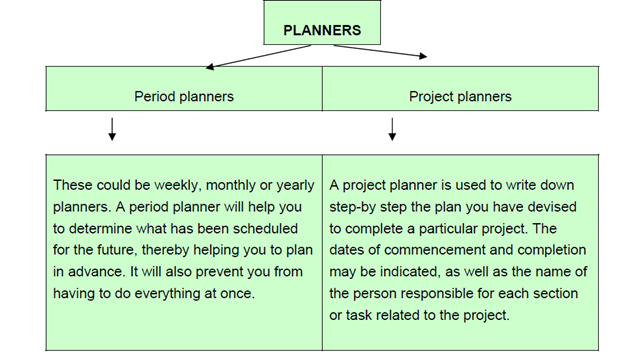
Planners
We can distinguish between planners for a certain period of time (period planners) and planners drawn up for a specific activity (project planners).
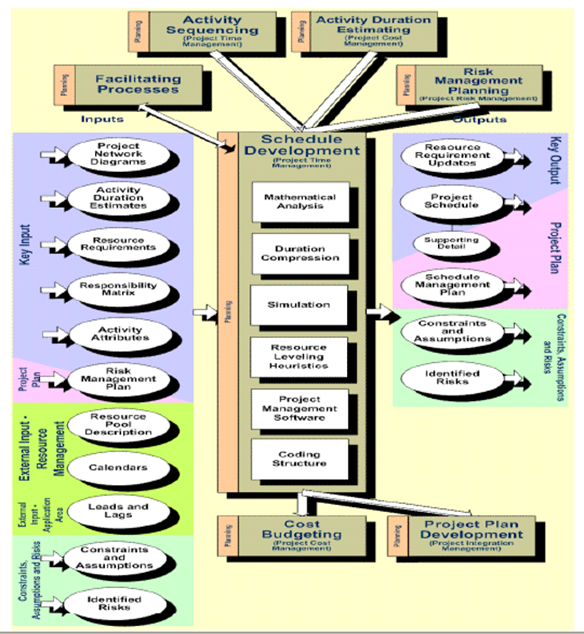
An example of a schedule development process diagram:
Remember:
Time is money and therefore it is important to be aware of how time is utilised.
Prioritise Tasks
STEP 1: List Functions or Tasks That Must Be Performed
Time management is a seven-step process that one in an organisation of any size can follow to gain control of both their own time and that of their team members. The essence of this process is control. It is important to remember that control must have a purpose and be directed. It cannot be a mere demand for blind obedience or rote activity. Such narrow-minded dedication can be as dangerous as no control at all. The point is to develop reasonable, realistic objectives and ways to achieve them. The control that follows will be appropriate and lead the business toward the success it deserves.
The seven steps of Time Management are:
- List functions or tasks that must be performed.
- Determine the time for each task or function.
- Analyze how tasks or functions are now being performed.
- Construct a skills inventory of key personnel.
- Calculate the percentage of the organisation's total time to be spent on each activity.
- Construct a Functional Time-Use matrix.
- Formulate a Time Use budget
The consequences of doing a poor or ineffective job of managing time are particularly obvious in smaller organisations. When the owners or managers don't do the jobs that are their responsibility in small companies, the jobs just do not get done, In more complex organisations, where delegation comes into play, Time-Use failures may not be so obvious.
They are also probably not as significant, because with more people working it is not as likely that certain tasks will not be done at all. Instead, they might not be done thoroughly. That is still a problem, but not as great a one as work completely neglected.
It seems obvious- that in order to make a schedule of anything it is firstly necessary to identify what needs to be done. However, if it is so obvious, why doesn't everyone do it, particularly these smaller business owner/managers, and especially when the consequences of not identifying needs are so severe? There are a lot of excuses for these failures, most of them not very good.
There is sheer ignorance of the total activity, its purposes and functions. Some owners feel that the business is so dynamic it is impossible to anticipate any activities, there can be no discernible routine, no rhythm can be followed, and therefore the manager must simply react to whatever happens.
Nothing could be further from the truth. Although many owner/managers of smaller businesses, along with key managers of discrete organisational subunits, feel their situations are unique, they generally face the same sets of problems as their peers in other businesses. There is a routine that is common to virtually all enterprises. Management science identified the activities that make up this routine long ago and different theorists are quick to point out their importance.
Note:
Any business must be viewed as a system composed of interrelated parts. These parts must operate in balance with each other if the business is to perform effectively: However, there is always the danger that some parts will overshadow others. It is a problem that emerges from simple enough causes. Every person has his or her own area of expertise or other area of particular interest, frequently to the detriment of other parts of the business.
No matter what approach is taken for analyzing the tasks and activities required for the business operation, those tasks and activities must be listed, along with a notation of the frequency with which they are required.
These activities can usually be divided into the following categories; routine daily/weekly tasks, periodic (monthly or other) tasks, and exception tasks. In addition, some activities are ongoing, but intuitive.
The daily chores include those that must be done frequently or on a very regular basis. Although these are the nuts and bolts of any operation, they are sometimes the most difficult to identify.
The reason for this apparent contradiction is that because they are done so regularly, they are done automatically. Therefore, they do not come to mind readily when the list is being compiled.
STEP 2: Determine the Time Required for Each Task or Function
Some managers seem to enjoy working 100 hours a week, 52 weeks a year. They not only enjoy it; they thrive on it. Most managers, however, do not enjoy such grueling schedules, and yet in spite of their best efforts find themselves running harder and harder for longer and longer hours just to stay in the same place.
STEP 2 is designed to help alleviate this problem. Taken in concert with STEP 3, it will help to form the time budget.
Effective time management involves not only knowing how long each necessary function or task should take, but also ranking the various tasks. It is necessary to establish priorities.
Dividing the tasks into categories and then ranking the categories may prove to be one helpful approach. It is critical in this exercise to write down all schedules and dates so that things will get done when they have to and will not be so apt to fall through the cracks. Once identified, the necessary tasks and functions, and their allotted times can be organized in tabular fashion.
The identification of needed organisational activities is a process that improves with repetition. By putting the tasks and times on paper and reviewing them over a few weeks, it will be found that rankings may change and times allocated will tend to be corrected by experience. After this present performance is analyzed it will be possible to get an idea of where time is being spent and misspent.
STEP 3: Analyse How Tasks or Functions are NOW being performedThe more formal title of this step is Functional Task Analysis, and the objective is to find out what the different key individuals in the organisation actually do with their time on a micro level and, on a macro level, and who is actually doing what within the organisation. There are two goals in this process:
Determine all the functions and activities that need to be performed and are being performed in order to make the organisation function, and
Look at the relative distribution of these tasks and activities by the amount of time used and the percentage of time allocated to each, all with the objective of establishing a new schedule, and very probably a new set of priorities. Exhibit A can be used.
This form can then be carried around on a clipboard so that every time a task or an activity is performed, it can be recorded. The Functional Time-Use Analysis approach can be tedious, but it is essential to this process and provides valuable insight. It is the only way to find out exactly how time is being used in an organisation, short of hiring someone with a stopwatch and a pad to follow everyone around. It is important that the analysis be performed not only throughout the usual working hours, but at other times as well. Many people work at home, whether they intend to or not, and they work away from the job at other odd times. These extra units of time must be included in the analysis in order to have a complete picture of what is being done and what needs to be done.
Results from using this form alone are often spectacular. It may be that a key person is spending a lot of time with a very genial customer or worker because it is a naturally pleasant way to spend time, having nothing to do with the relative importance of that customer or worker to the grand scheme of things. It may also be found that unpleasant tasks are receiving incredibly short shrift in spite of their importance.
People frequently spend more time worrying about not doing certain work than in doing the job. They may convince themselves by their worrying that a certain undesirable activity is receiving much more constructive attention and time than is actually the case.
People play a great many mental and emotional games with their sense of what they do, its relative importance, and the time allocated to each of their tasks. The point of this step is to determine how much time is actually being devoted to each activity as a prerequisite to bringing time use under better control.
Although the Functional Time-Use Analysis Form is not difficult to use, it is extremely difficult to become accustomed to, and will be a huge nuisance until it becomes second nature. Lawyers, accountants, and other such specialized consultants bill on a Time-Use basis and divide their days into very small segments so that they can identify whom to bill for every moment. This is essentially what the Functional Time-Use Analysis Form is structured to do, to account for every moment, to bill it to some task or function, to assure that every moment of time is paid for at the highest level possible.
STEP 4: Construct a Skills Inventory of Key PersonnelThis step affords a golden opportunity for self-assessment for each of the key members of the management team. The objective is to determine how key management people should spend their time.
- What are their strengths and weaknesses?
- What must each do, given their strengths and weaknesses?
- What must each do, given their strengths and areas of responsibility that no one else can do?
- In essence, what does each person like to do and what is he or she good at?
- Who will do what?
As with STEP 2, this analysis should be performed during a non-pressure period so that it will receive the care, attention, and thought it requires. But don't wait for a free period; it will never come. The better alternative is to create one specifically for this activity. Thoughtful reflection is an ideal activity for a retreat environment.
This Step can be taken very straightforwardly. By dividing the possible activities each key person might perform into the following categories, which have repeatedly been found useful, and then collating the answers with those for Step 3, it is possible to arrive at an accurate assessment of current Time-Use effectiveness:
- What is each person especially good at? ...bad at?
- What does each person especially like to do? ...dislike doing?
- What must be done by each key person that no one else can do?
STEP 5: Calculate the percentage of the organisation’s total time to be spent on each activity
This is another reality testing step. Working with 100 percent of time before turning to actual hours and minutes, users of the approach outlined here often find that because they have placed unusual emphasis on time use in STEP 2 and frittered away a lot of time as revealed by the results in STEP 3, they were short changing major areas of the business.
Preparing time budgets is far more difficult than preparing other types of budgets.
Guidelines are available that show what the average expenses and other ratio relationships are for similar businesses at similar levels of volume and represent the usual distribution of cash assets among different areas of the business. These guidelines are especially useful because they are averages of successful companies, and so, significant deviations from the operating statistics should act as a warning to the wise.
STEP 6: Construct a Functional Time-Use matrixIf the priorities make sense and hang together coherently, it is possible to make realistic and effective use of time as well as the other assets of the organisation. Therefore, this step is concerned with a careful rethinking and possible re-ranking of priorities. STEPS 1 and 4 have shown what must be done, by whom, and with what frequency. STEP 3 shows what each person actually does. STEP 5, then, provides the opportunity to rethink priorities from a strict Time-Use viewpoint.
At this point, the systematic process has produced all the parts. Now the challenge is to assemble these parts into a coherent plan of action. The device used for this assembly process is a Functional Time-Use Analysis matrix. It is in part a managerial checklist and in part a trial land-error allocation of personnel to tasks and time. It can range from a fairly simple system, to a complex computer- generated production schedule.
The matrix contains the following titles:
- Task: Shows each task or function to be performed
- Time Required: Shows the time (in minutes here) required for each task
- Time Available: Shows the actual distribution of each employee's time (including the Boss)
- Total Time Available: Shows the sum of time scheduled for each function
- Time Needed: Recognizes negative deviations or gaps in the schedule
- Total: Sums the total time required
- Total Employee Time Available: Shows the total for all employees (again in minutes).
Employee time can be totaled across and should equal total time required. This is a quick way to identify deficiencies in the total schedule
STEP 7: Formulate a Time-Use BudgetThis last step is almost a formality if the preceding steps were thorough. Experience generated through the earlier steps will have revealed most of the gaps in the planning activity. It is essential when doing the schedule not to make it too tight.
Slippage will inevitably occur and should be built into the Time-Use Budget. An override of 10 or even 20 percent may be necessary to allow time to respond to daily or monthly fluctuations. A tight schedule assumes a perfect world. Murphy's Law states that if something can go wrong, it will, and so it is necessary to plan for it.
The matrix approach is a powerful one. A key concern in any business is a smooth workflow. This can be aided by matrix analysis. Workstations have to be set up; that takes time and the production runs can be scheduled only after setup time is figured.
Downtime has costs; it appears day after day both on the matrix and in review. Decisions can best be made on the basis of the hard information generated by these controls.
Time is an asset that is often neglected. Squandered, it defeats the best-laid plans. Time carefully used makes management easier, more effective, and less panicked. By following the seven-step approach to time management; you can dramatically increase the knowledge of how any business works and use time more effectively. The added knowledge is a bonus and a powerful one.
The Time Planning Schedule Worksheet is frequently found to be an excellent tool for planning time use in any situation. By stating the objectives for the week (or month, year, or day) before scheduling time, you will leave few important activities undone.
This process automatically forces the establishment of priorities. When activities or needs are listed in this way and then prioritized, the most important receive the attention and time they require.
The Time Planning Schedule is both a device to help ensure that what must get done gets scheduled, and a review tool to be sure that scheduled activities have been carried out. For both purposes it is valuable.

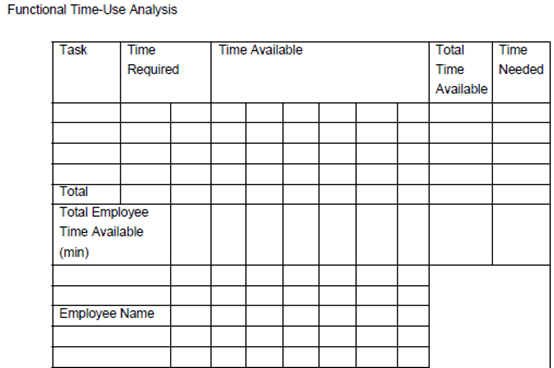
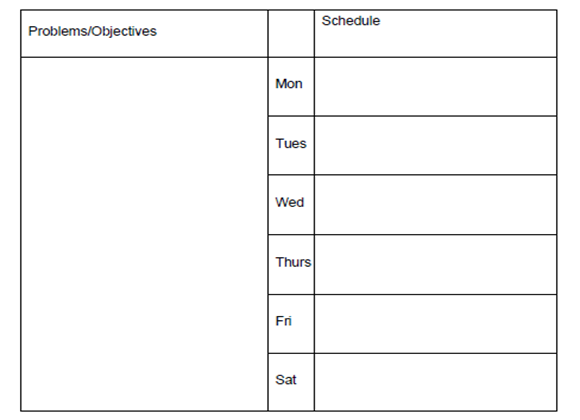
Fig. 2 – Time Planning Schedule
Implement and Maintain Personal and Team Task Lists
How can you do important things when it seems as if everything needs to be done first?
In this regard you are well advised to make use of the Pareto principal of prioritising activities and tasks. Spend more time on the 20% activity of your activities which address 80% of your responsibilities and problems, instead of spending 80% of your time on only 20% of your responsibilities.
Therefore, attend first to those issues that:
- Cover 80% of your responsibilities
- Solve 80% of your problems
- Provide 80% of your profits
Many people think that they are the only ones competent enough to perform a particular task. It is important to get out of the habit of attempting to do all the work yourself. Before starting a task, ask: “Why me? Or “Could someone else perhaps not do this on my behalf?”
Delegate work whenever possible. This does not mean simply passing your work to someone else. If constructively applied, delegation ensures that other people are also given the opportunity to acquire the skills and training to do the work.
How would you develop procedures and which networks will you put in place for your own business?
Provided that your data has been collected strictly and accurately, you should easily be able to determine which events occur regularly, take up to much time, keep staff at the office until late and create unnecessary tension.
Estimates which are based on fact and are accurate can be a tremendous advantage in project control. Estimates which are no more than a guess or someone’s wish can be extremely detrimental, that is why it is so important that your estimates are sourced from responsible individuals unless estimates have a real basis in fact and are developed by the individuals actually assigned to do the work, they are best ignored except when reporting progress to management.
The value of estimates is in productively allocating resources and in coordination of task interdependencies. Estimates should not be used as evaluation tools. The owner or manager must be free to adjust plans and estimates based on actual project feedback without having to justify why initial estimates were not totally accurate.
Remember – plans are guides. Estimates are just that, our best and most educated guess about what should happen. The reality is the actual project work that is being performed. If the reality does not always conform to the plan, it is likely that the plan need some modifications.
Activity Duration Estimating involves assessing the number of work periods likely to be needed to complete each identified activity. The person or group on the project team who is most familiar with the nature of the specific activity should make, or at least approve the estimate.
Effective time management involves not only knowing how long each necessary function or task should take, but also ranking the various tasks. It is important to set deadlines for each procedure or process.
Start with realistic but precise goals for your firm, including deadlines. For example, don't just say that you want to increase sales; instead, decide that you want sales to reach R100,000 by December.
Then write down the steps you can take to meet those goals on time, and set deadlines for completing those steps. Consult your goal list every day, and make sure you are doing what you need to do to meet your objectives.
Dealing with Deadlines
There are two basic types of people in life-those who let things happen to them and those who set goals and make things happen for them, in dealing with deadlines, the same principle applies. You can either wait or let the deadline creep up on you, or you can take matters into evaluate the situation, calculate your next move, and set out for your goal.
Finding Positive Motivation
When you've got a deadline staring you down, the last thing you want to do is start worrying that something terrible is going to happen deadline. When you focus on the negative, all you can see is the problem, not the solution. Find a positive motivation for yourself.
For example, imagine what will happen when you do meet the deadline. Think about how pleased you will be. Or promise yourself a new book to read, an afternoon at a spa, a day at the beach, or a night at the movies.
Establishing Goals and Priorities
Any deadline represents an ending or the completion of a project, the resolution of a problem. But to reach that end you've got to start at set goals. for yourself along the way.
When you are establishing a goal, be as specific as possible. Write down exactly what you're going after. The more detailed the goal, the better, because you'll know precisely what you're trying to accomplish.
You also need to know why you are striving for a certain goal-it's not enough to know that you just want something, you also need to know why. Your intention is the driving force-it's the reason you'll work hard to reach your goal.
Once you've established a goal, you can determine its importance. This establishes your priorities so you can see what takes precedence. Here are a few questions to ask yourself as you measure the importance of a goal:
- Is it urgent?
- Does it require your immediate attention?
- Are there any immediate benefits or rewards associated with it?
- Is it valuable?
Making a List
As with any large undertaking, tackling a big project with a deadline will become much easier when you break the big task down into smaller units. Making a list is as simple as writing down all the steps you need to take to get something done. For example, if your big project is hosting a function. Break it down into a list of steps, beginning with creating a guest list and ending with decorating the venue.
When you take charge of a deadline, you become the architect of your own goals. You get to say what's important and when it gets done six steps, you'll find that those intimidating deadlines are actually well within your reach:
- Set specific goals with deadlines or targets project.
- Find your motivation.
- Know why you want to reach a goal.
- Establish the importance of your goals.
- Break down each in bite-sized tasks.
- Establish the priorities of all the smaller tasks.
Step-by-step, your work is done!
It will be wise to distribute a personal activity schedule. E.g.

The project manager or business owner should receive constant feedback on the activity schedule. Management should be notified of any interruptions in the schedule.
Develop a daily business activity schedule for your business. You can use the format as in the example or design your own schedule.
A lot of our daily responsibilities require us to deal with a lot of interruptions, unanticipated events. These are not a problem. It is the unwanted, unnecessary interruptions that keep us from focusing on what really needs to get done. We can also call these interruptions “time wasters” or “time stealers”
Some “time wasters”
Interruptions – Telephone: Although the telephone is one of the most important means of communication in a company, it is also regarded as great time waster. Furthermore it is difficult to assess the output of the user of the telephone.
The reasons for this may be the following:
- Calls are frequently unplanned and too long-winded.
- Calls are often not directed at priorities.
- The caller may lack self-discipline and a sense of sense of time.
Bear in mind the following tips to ensure that the telephone remains an aid and does not degenerate into a time-waster:
Incoming calls
o Return calls at the same time every day.
o Try to attach a time limit to all calls, limit calls to three minutes each.
Interruptions – Personal or unexpected visitors: Limit visits from family members to private time. Insist that visitors make an appointment before time. Being sociable often also waste your time for reasons other than being. The five deadliest words that rob your time are: “Have you got a minute?”
Meetings
Some meetings should never take place. Stick to the agenda during a meeting. Do not schedule meetings if there is nothing to discuss. Plan and prepare for all meetings.
Tasks you should have delegated skills and training to do the work. – Delegate work whenever possible. This is the best way to build a team’s moral and reducing workload at the same time. The general rule is- if one of your staff can do it 80% as well as you, the delegate it.
Procrastination and indecision
Do not postpone until later. The reasons for procrastination are endless: a cup of coffee, private telephone calls, fear of making wrong decisions or being disorganized.
How to avoid procrastination
- Determine objectives and keep to them.
- Begin every day with the most important tasks, whilst you still have the energy for it.
- Divide complex tasks into smaller units.
Acting with incomplete information
Be well informed. Answer questions immediately. It saves a lot of time and effort.
Dealing with team members
See to it that teams are motivated and well informed regarding the work that they need to do.
Inabilities to say “no”- We often do everything in our power to accommodate everybody. In this way we end up with more unwanted responsibilities than we have time for. The general rule is if people can dump their work and problems on your shoulders they will do it. Some of the most stressed people around lack the skill to just say “No” in fear of upsetting people.
Desk management and personal disorganisation – The “messy desk” syndrome relates to the situation where documents are spread all over your desk while not necessarily being an indication that you are working very hard. Shuffling documents around wastes time and leads to inefficiency; remove everything that does not relate directly to what you are currently working on.
Other issues include:
- Unclear communication.
- Inadequate technical knowledge.
- Unclear objectives and priorities.
- Lack of planning.
Always define your objectives as clearly as possible.
Do you find you are not doing what you want because your goals have not been set? One of the factors which mark out successful people is their ability to work out what they want to achieve and have written goals which they can review them constantly.
Your long term goals should impact on your daily activities and be included on your "to do" list. Without a goal or objective people tend to just drift personally and professionally. Refer to SMART goals as done in a previous Unit standard.
Analyse your use of time.
Are you spending enough time on the projects which although may not be urgent now are the things you need to do to develop yourself or your career. If you are constantly asking yourself "What is the most important use of my time, right now?" it will help you to focus on 'important tasks' and stop reacting to tasks which seem urgent (or pleasant to do) but carry no importance towards your goals.
Have a plan.
How can you achieve your goals without a plan? Most people know what they want but have no plan to achieve it except by sheer hard work. Your yearly plan should be reviewed daily and reset as your achievements are met. Successful people make lists constantly. It enables them to stay on top of priorities and enable them to remain flexible to changing priorities. This should be done for both personal and business goals.
Action plan analysis
Problems will always occur, the value of a good plan is to identify them early and seek out solutions. Good time management enables you to measure the progress towards your goals because "What you can measure, you can control". Always try to be proactive.
Time management (or self management) is not a hard subject to understand, but unless you are committed to build time management techniques into your daily routine you'll only achieve partial (or no) results and then make comments such as "I tried time management once and it doesn't work for me". The lesson to learn is that the more time we spend planning our time and activities the more time we will have for those activities. By setting goals and eliminating time wasters and doing this everyday you may find you will have extra time in the week to spend on those people and activities most important to you.
Setting Smart Goals
SMART Goals are:
S Specific – they must indicate how much/many
M Measurable – you must have a means of testing whether you have met them
A Achievable and Action - they must be achievable in the time you have and they must say what will be done
R Relevant – they must be relevant to the needs of the people you are serving and to the aims of your organisation or to yourself
T Time bound - they must indicate by when
Planning for achievement
Step One: What are the different ways to achieve this goal? Generate at least three different options.
Step Two: Which of these options will be the best to achieve the desired goal. Evaluate the options by applying some criteria to measure efficiency and effectiveness.
Step Three: What are the milestones that need to be put in place to reach the goal? Map out the milestones
Step Four: What activities/actions are needed to complete each milestone? Make a list of ordered steps to follow.
Step Five: What resources or inputs are needed to implement this plan? Time, money, expert information, transport and equipment are some examples. Where will you find these resources?
Step Six: How do we capture all this information in a helpful way? A written plan will help us keep on track and not forget important details. Draw up a detailed plan. (refer to operational planning format and example)
Step Seven: Does the plan have clear bench marks? The completion of a milestone may be used as a benchmark. Including a regular activity that reviews and monitors progress helps to keep on track and adjust the plan. Involving another person to assist with monitoring progress is helpful.
Step Eight: Take action/ implement the plan!!!!
Organising your workspace
If you think you don’t have time to plan, trust us, you don’t have time not to! Let’s look at a few things you can do to make your time at work productive and less stressful.
Organize Your Workspace
Keep your desk organized. Use file folders, baskets, or containers – whatever you need to do to keep things neat. It can also be helpful to group like items together.
Electronic Organisation
Don’t forget, your workspace should extend to your computer, too. Make sure your electronic files mirror your hard copies, and that you have a way of keeping things organized. Don’t just throw everything onto the desktop or into My Documents.
It’s also important to keep your e-mail organized, too. E-mail can be a great tool, but it can also negatively affect productivity. Set your e-mail program to only check your e-mail once every hour. Some time management experts even suggest dealing with e-mail only once or twice a day.
Nearly every e-mail application offers you the ability to create folders to organize your messages, just like you organize files on your hard drive.
Most applications also feature the ability to configure rules to automatically move e-mails with a particular subject or sender to a particular folder. Take the time to learn how to use these features and you’ll be rewarded a thousand fold.
Prioritize Your Tasks
My favourite, most stress-reducing tool is a notebook. Every day, before I leave work, I make a list of the tasks I need to accomplish the next day. Then, the next morning, I come in, review my e-mail, and add tasks to the list, if necessary. Finally, I highlight the top three items and focus on those during the day. At the end of the day, I start a new list for the next day, and transfer any uncompleted items to that list. It’s simple, it’s easy, and it provides documentation if I need it.